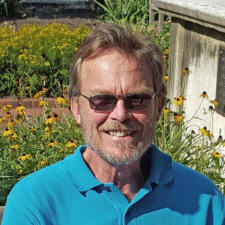
 Ted Watson has been a member of the MDP Inspired Design Team since 2011. With 50 years of industry experience—as an architect and as a mason—he brings a wealth of design and construction knowledge, creativity, and valuable insights to the firm’s inspired design process.
While Ted maintains an “Old School” sign on his office window where he continues to work through design challenges drawing by hand, he is always bringing something new to the MDP Team. His passion, problem solving and drive for getting the details right push the team and enhance project solutions.
Ted’s eye for detail and project management started as a child, when he spent time in his closet writing a newspaper that he and his sisters published and circulated. “For most of my young life I grew up on the Bryn Mawr College campus where my father was Chairman of Geology. I was surrounded by a fantastic world of amazing, expressive, intellectual folks who were full of life and full of theater,” describes Ted.
He started drawing at 15 and enjoyed building short wave radios, but it wasn’t until college, while majoring in anthropology, that his path to architecture emerged. A colleague and sculptor named Edmund Whiting—who had been a student of Frank Lloyd Wright—liked Ted’s artwork and encouraged him to leave anthropology to pursue architecture. “You wouldn’t necessarily think anthropology was a path to architecture, but it really is. It is the understanding of mankind and humanity,” says Ted.
Ted headed to the University of Pennsylvania to study architecture and found himself immersed in a spectacular program with noteworthy faculty. “I was there when Louis Kahn was still leading the architecture program, and we had the fantastic Scottish landscape architect, Ian McHarg, as well as the famous city planner Edmund Bacon,” describes Ted. “It was a magnificent time to be at Penn.”
A two-year tour of duty with the US Army Corp of Engineers interrupted his educational pursuits. Upon his return to Penn, he won a Silver Medal for Design and was later a critic for the program from 1979 – 1989.
Ted’s career includes time as a drafter, carpenter, and mason. He spent ten years running his own masonry business before starting an over 30-year architectural journey with one firm. While the firm changed names during that time, Ted helped maintain consistency advancing in responsibility from project designer, to project director and manager, to partner. As responsibilities increased, design leadership continued as his focus. His project work included long-term care, healthcare, and education.
“I enjoyed the wonderful diversity of the project work and was the architect for some of those clients for over 30 years,” says Ted. “To hold a client for that length of time in the architecture business is almost unprecedented; it is a very competitive industry. Over the course of that time, with one client, I had the opportunity to transform a small reform school into a dynamic, competitive college prep school. It was a wonderful achievement.”
Ted’s connection to Sam Merlino early in his career is what guided him to MDP in 2011. He had also worked with Chris Mullin at a previous firm and knew he too would be a valuable addition to MDP. “Chris and I were part of a great team at our previous firm. We did amazing things. As his boss, I was quite impressed working with him,” says Ted. “I like the humor in the fact that now I am working for Chris—and there is no better person I could be working for.”
“Ted is the last of a dying breed. They no longer teach the skills he has at any level of education,” says Chris Mullin, Senior Associate and Director of Interior Architecture at MDP. “His throw away hand drawings that we study just to dismiss planning options are artwork. His final hand drawings use color, annotation, and layering to show energy, movement, and development that cannot be done on a computer. As much as we all complain about his process—it is his process that informs the well-thought-out planning, adjacencies, and flow that always transforms into a great architectural design. It is what the team works with and evolves into an inspirational design. In the end, it yields satisfied clients. Ted’s process makes us all better designers.”
 When it comes to the world of senior living, Ted relishes the opportunity to create community. “The goal we strive so hard to achieve is to bring the vitality of a village to each community, and I have been fortunate to do this with so many projects,” says Ted. “We bring life to the residents with exciting dining and entertainment venues. It is fun, but also hard, especially with renovations.”
Ted notes the award-winning Friendship Village dining transformation as a challenging renovation effort. He credits Mullin for his fortitude on this effort as well as his own will to not give up easily. While there were many obstacles, he is quite proud of MDP’s accomplishment and the award recognition it has received.
From rendering an eight-foot site plan in 1977 of Cathedral Village, one of the earliest continuing care retirement communities in Philadelphia, to his work on MDP projects such as Friendship Village, The Vista, Echo Lake, and Broadview at Purchase College, Ted is committed to the senior living industry. He is grateful to be part of the MDP inspired design process and still creating communities at the age of 75.
“In my room piled high with hand drawings, I am very lucky that Bruce and the rest of the MDP Team consider my work valuable,” says Ted.
Enjoy this Q&A with Ted:
1. Share a few Ted fun facts.
I am 75 with a wonderful wife who is 54, and we have two great kids just turning 18.
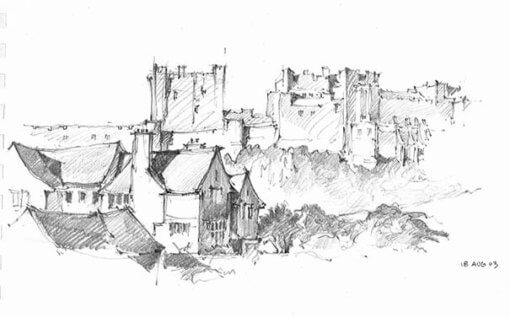
My avocation is to sketch and draw—as deep into nature as I can get. Up until the pandemic, I spent 25 years traveling to England and Scotland every year. There is an idyllic village where I go—but I will not mention it by name. For me it is a place that just has it all—and I wander the fields and sketch its beauty.
I also spent a decade sketching in the Plough & Stars, an Irish pub in Philadelphia. I would sit in a corner drawing the musicians and other interesting characters. There was a nice article written about it – Light and Shadows at the Plough & Stars.

2. What is architecturally interesting about your home?
I have lived on the same little street in Philadelphia for 41 years in a house built in 1757. It is located on Elfreths Alley, the oldest continuously occupied residential street in America.
3. Share a mantra or inspirational quote that is meaningful to you.
“I sense Light as the giver of all presences, and material as spent Light. What is made of Light casts a shadow, and the shadow belongs to Light.” — Louis Kahn
4. If you had a theme song, what would it be? Why?
Southern Cross – Crosby, Stills & Nash (I’m a sailor from the 60’s)
But on any given day you will hear Johannes Brahms, The Allman Brothers or Dire Straits coming from my room in the office…and Bruce asking me to turn it down.